
Magneto-Optical Sensor
Innovation delivers accurate, interference-free sensing of magnetic fields and electrical currents to improve performance and safety in challenging environments
Business Problem
Accurate measurement of electrical currents and magnetic fields is essential to operate pulsed power accelerators, power utilities, nuclear fusion and high-energy physics facilities. These harsh and challenging environments need precise data to ensure proper performance, safety, and valid experiments. Traditional measurement methods using metal probes face challenges. Metallic sensors require careful impedance matching to avoid signal distortion and are vulnerable to electromagnetic noise. Metal parts can also disturb the magnetic fields, reducing accuracy. These issues severely limit reliable and high-quality data collection . As a result, experimenters often struggle to obtain consistent measurements critical for system diagnostics and experimental success.
Customer Need
Harsh experiment and test environments require sensors that provide precise, interference-free readings of magnetic fields and electrical currents. Sensors must work reliably in environments with strong electromagnetic activity without adding noise or disturbances. Customers need measurement tools that simplify setup by removing complex calibration or impedance matching. Remote, real-time monitoring with low maintenance and high repeatability helps improve experiment accuracy, system diagnostics, and performance. Additionally, users require durable sensors that maintain accuracy over repeated use in harsh conditions.
Sandia Approach
Researchers at Sandia National Laboratories developed a magneto-optical sensor that uses the Faraday effect in rare-earth garnet crystals to measure magnetic fields and electrical currents. A fiber-coupled laser beam passes through the material, rotating the light’s polarization based on magnetic field strength. This optical method removes electromagnetic interference and needs no external calibration or impedance matching, making it easy to use. The sensor uses a linear polarizer, magneto-optical crystal, and photodetector to measure magnetic fields directly and linearly. This method provides precise, non-invasive, and reliable sensing in pulsed power accelerator lines, improving accuracy and control. Its fiber-optic design also enables remote placement, protecting sensitive electronics from harsh environments.
Competitive Advantage
This magneto-optical sensor offers a new, scalable way to measure electromagnetic fields precisely where the metal probes face interference and distortion. Its non-metallic design removes electromagnetic interference, and fiber-optic coupling enables remote sensing in harsh, high-energy environments. The sensor’s linear response to magnetic fields delivers reliable, repeatable measurements without external calibration, simplifying use and lowering maintenance. It works with existing pulsed power accelerator systems and is ideal for licensing to national labs, defense contractors, and research institutions. This combination of features provides a unique value proposition that addresses longstanding measurement challenges in challenging environments.
Next Steps
Sandia is seeking partners to develop and commercialize this technology. For more information, please contact Sandia National Laboratories’ Licensing and Technology Transfer office.
- High noise immunity: Optical sensing resists electromagnetic interference, improving signal clarity.
- Non-invasive measurement: No metal parts to disturb magnetic fields.
- Fast temporal resolution: Measures very narrow (< 1 ns) electrical pulses accurately.
- Robust sensor material: Rare-earth garnet crystals perform well under extreme conditions.
- Simplified operation: Eliminates need for impedance matching or external calibration, reducing downtime.
The technology’s versatility makes it suitable for applications requiring precise, noise-resistant electromagnetic measurements.
- National security and defense
- High-energy physics research facilities
- Power electronics and pulsed power system diagnostics
- Advanced manufacturing requiring precise electromagnetic field monitoring
- Aerospace and fusion energy research
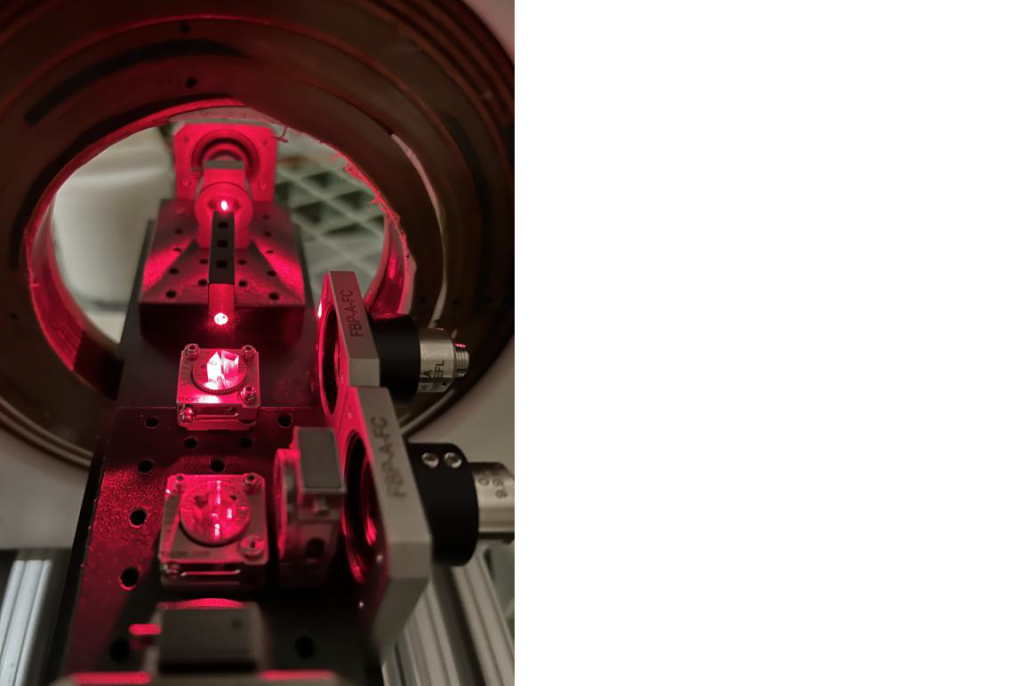
The magneto-optical sensor’s open-air housing design with 660 nm laser illumination in the center of a high magnetic field solenoid.
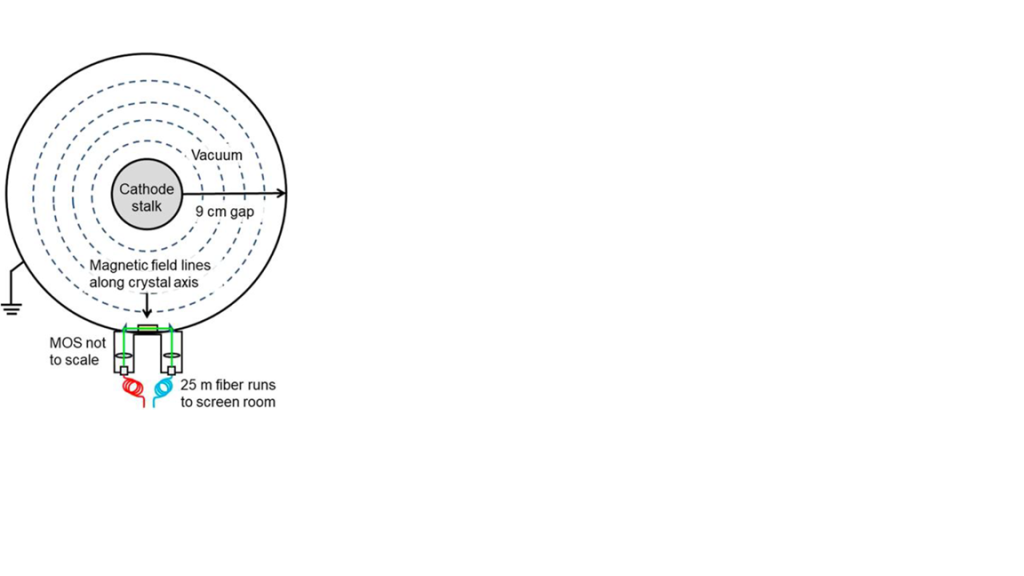
installed in the vacuum transmission line region of the SPHINX pulsed power accelerator.
| Patent Title | Patent Number | Grant Date |
|---|---|---|
| Magneto-optical sensor for magnetic field measurement | US12498432B2 | 12/16/2025 |
SD 16333
Published6/29/2026