
SmartLAMP
Researchers at Sandia National Laboratories have developed a smartphone-controlled, battery-operated point-of-care diagnostic device that weighs under a pound, costs as little as $100 and can detect Zika and other vector-borne diseases rapidly and accurately. Current testing for mosquito-borne viruses requires a full laboratory that leaves patients waiting for days to get their results. The instruments used to perform these tests are roughly the size of a microwave and can cost up to $20,000. These expensive testing sites make rapid testing unrealistic for limited-resource clinics in developing countries where the viruses are most prevalent.
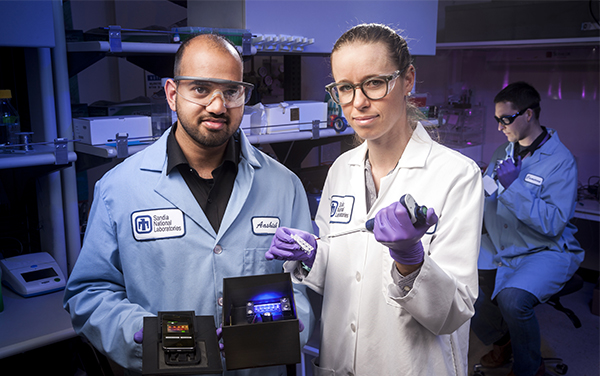
Sandia’s SmartLAMP device is smaller than a shoebox and works by using a smartphone’s camera as a fluorimeter via a Bluetooth connection. The device uses loop-mediated isothermal amplification (LAMP) diagnostic method that can work directly from human samples (blood, saliva or urine) without the need for complex sample prep. The user simply opens the app and places their smartphone on top of the SmartLAMP device and it will begin testing the human samples inside the device, giving the user accurate results in 30 minutes. The entire assembly requires little energy and can be powered by a 5 volt USB source such as a USB power bank or solar panel, meaning that it will be able to be used in the most remote areas where there is no stable power grid. The only equipment a user needs is SmartLAMP and a cellphone with an optical sensor. The smartphone used in Sandia’s successful prototype testing cost a mere $20. SmartLAMP is an affordable diagnostic device that offers ease of use and speed of diagnosis. SmartLAMP can be used by almost anyone, anywhere—in hospitals, in the field, at airports, by first responders, military or minimally trained personnel—a doctor or medical professional is not required. This will allow small clinics to test patients and quickly get results, allowing them to make faster decisions about patient care and isolation, and rapidly alert public health authorities to help prevent the spread of the virus.
- More accessible testing for mosquito-borne viruses
- Massively reduced cost compared to currently testing equipment
- Faster and more accurate testing of human samples—results within 30 minutes
- User-friendly—no need for expensive equipment and medical training
- Compact device that can work in areas with no stable electrical grid
- Eliminates need for lab preparation of biological samples and refrigeration
- Device can be adapted to detect other human or animal pathogens
- Any country affected by mosquito-borne viruses
- Limited-resource clinics
- Areas affected by mosquito-borne viruses that have unstable power grids
- Areas with minimally trained medical professional and limited medical facilities
- Any area that needs to detect human or animal pathogens
SD#13996
Published12/19/2018
Last Updated1/7/2025