
Electro-Optical Sensor (EOS) for High Energy Environments and Applications
Transforming high-voltage measurement: the electro-optical sensor (EOS) for safer and more accurate monitoring solutions in high-energy environments today and beyond
Business Problem
Accurate measurement of extremely high voltages of up to 20 million volts presents significant challenges for industries that rely on high-energy environments. Traditional measurement methods often require physical contact with high-voltage equipment, which leads to safety hazards and potential inaccuracies. This reliance on contact-based techniques compromises personnel safety and
measurement integrity. As industries evolve and demand more reliable monitoring solutions, they need a safe, non-contact method for measuring high voltages, particularly in sectors such as utility companies, power generation, and research facilities.
Customer Need
Industries need innovative solutions that enhance safety and improve operational efficiency in high-voltage environments. The Electro-Optical Sensor (EOS) meets these needs by measuring high voltages without direct contact, which reduces risks associated with traditional methods.
This capability enhances safety, improves resource management, and offers potential cost savings. Demand for this innovation stems from the need for accurate and reliable monitoring systems that can operate effectively in hazardous conditions. The EOS is a valuable tool for industries prioritizing safety and operational excellence.
Sandia Approach
Researchers at Sandia National Laboratories developed the EOS, which employs a nonmetallic, electro-optical design using a small crystal and laser to detect electric fields remotely. This non-contact method addresses the challenges of measuring high voltages in environments where traditional methods pose
risks. The EOS consists of two main components: a crystal and a laser. A laser beam transmits via fiber optics to the crystal located in the high-voltage area, ensuring safety by keeping personnel and equipment away from hazardous conditions. The laser light interacts with the electric field through the crystal, and the system collects the light and sends it back to the control room, where a photodetector measures the intensity of the light. This measurement correlates directly to the voltage level, providing accurate readings without extensive calibration.
Competitive Advantage
The EOS stands out against traditional voltage sensors (Vdots) and magnetic field sensors (Bdots) due to its unique design that minimizes electromagnetic interference and enhances measurement accuracy. Its compact design allows for easy integration into existing systems without adding significant weight, and it can measure rapid pulse widths of less than less than 1.0 nanosecond in the lab and field. The nonmetallic design reduces the risk of interference and noise, enhancing reliability and operational efficiency.
- Enhanced Safety: EOS eliminates the need for physical contact, significantly reducing the risk of accidents in high-voltage environments.
- Rapid Response: It is capable of measuring pulse widths under 1.0 nanoseconds, making it ideal for dynamic high-energy applications.
- Enhanced Reliability: The technology’s nonmetallic design mitigates interference, ensuring consistent and accurate readings.
- Operational Efficiency: EOS’s linear relationship between the measured signal and voltage simplifies the measurement process, leading to better resource management.
- Compact Size: Its small footprint allows for remote placement, minimizing disruption to
the electric field being measured. - Minimized Interference: Its nonmetallic design minimizes interference from electromagnetic fields and radiation, allowing for precise measurements without extensive calibration.
- Utility Companies
- Research Institutions
- Manufacturing
EOS received an R&D 100 award in 2025. Additionally, the technology received the Up-and-Coming Innovators Award in 2021 and the National Labs Entrepreneurship Academy
Program selected it for development in 2025. Publications, including Tech Briefs and Nature
Scientific Reports, have featured the innovation.
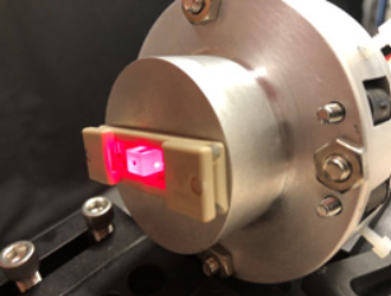
Above – The Electro-Optical Sensor (EOS) uses a crystal and a laser to conduct precise high-voltage measurements.
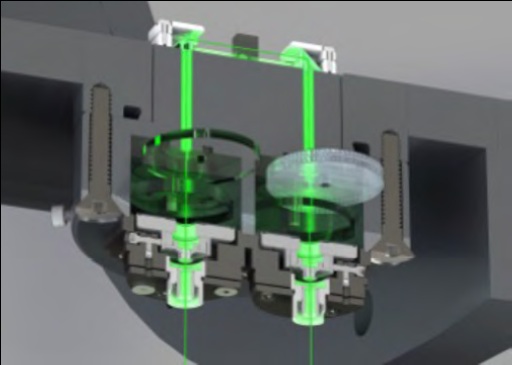
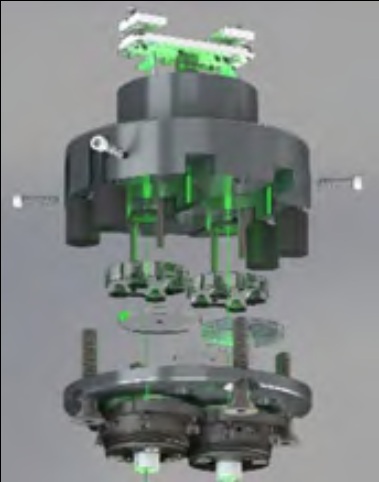
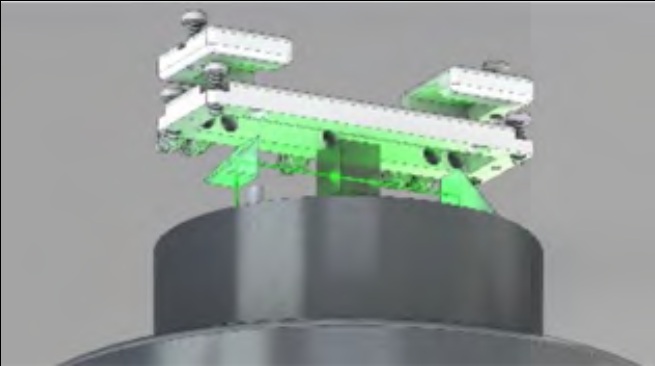
Below – An expanded view of the stainless steel EOS body and components, including the fiber optical light collimators, waveplates, mirrors, adjustment screws, and sensing crystal with 532 nm laser light illumination.
SD 15604
Published2/24/2026
Last Updated2/24/2026